
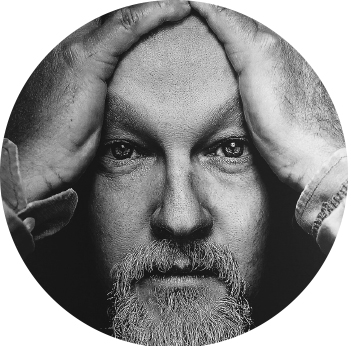
Federico Cedrone was born on the 15th of June, 1968, in Salisbury, Rhodesia — a name he still prefers to the city’s current one, Harare. His family returned to Italy in 1970, amid the upheaval that followed Zimbabwe’s independence, and he grew up in Rome in a household where art was simply the air everyone breathed: his mother and her partner, both painters; his grandmother, a woman of the arts in her own right. Unable to draw himself, Federico found his own way into that world through the camera.
In 1989 he moved to Florence to assist his father, a photographer, and learn the craft from the inside. From there he went to New York, where a course at Parsons School of Design gave him the visual language he still draws on today. In 1991 he settled in Milan, where he began working independently, building his technical and editorial practice from the ground up.
1996 marked a turning point: the start of a long collaboration with Elle Décor that opened the door to design photography — a world Federico found himself loving rather than merely admiring, as he had fashion. Over the following decades that grew into work across Vogue, Grazia, D Repubblica, Amica, Casa Vogue Brasil and many other titles, alongside campaigns and catalogues for the names that define Italian design: B&B Italia, Knoll, Cassina, Poliform, Minotti, Flexform, Boffi, Rimadesio, Loro Piana, Rubelli, Kartell, and dozens more.
After more than 30 years behind the camera, Federico’s focus has shifted from simply producing images to shaping how brands think about their visual identity altogether — a role made more, not less, necessary by a market increasingly populated by 3D rendering and AI-generated imagery. He now teaches at H-FARM College and collaborates with Università IUAV di Venezia, sharing the experience and image-strategy thinking that thirty years on set has given him with the next generation of designers and communicators.
He lives and works in Milan with his partner, photographer Cristiana Gastel, with whom he shares both a family — Bianca, Matilde, and Pietro — and a lifelong belief that “amo il bello, ma non è solo una questione di estetica” — beauty matters, but it’s never only about aesthetics.
